

Relieve Radiating Sciatic Nerve Pain, Numbness & Leg Cramps
“Piriformis trigger point dry needling, neural flossing, and pelvic realignment.”
Sciatica is characterized by sharp, burning, or shooting pain radiating along the path of the sciatic nerve—from the lower back through the hip and buttock down each leg. It is commonly caused by lumbar disc herniation, spinal canal stenosis, or piriformis syndrome (where the piriformis muscle spasms and entraps the sciatic nerve). Our specialized clinical protocol relieves nerve entrapment and restores free neural mobility.
Common Symptoms
- Burning, tingling, or electric-shock sensation down the back of the leg
- Constant buttock ache that worsens upon prolonged sitting
- Numbness or weakness in the calf, heel, or sole of the foot
- Sharp pain on standing up or while driving and stepping on the gas pedal
- Difficulty walking or putting full weight on the affected side
Root Biomechanical Causes
- L4-L5 or L5-S1 lumbar disc herniation impinging the sciatic nerve root
- Piriformis syndrome: Hypertonic deep gluteal muscles compressing the nerve
- Pelvic torsion and sacroiliac joint subluxation tilting the sciatic notch
- Spinal stenosis or degenerative spondylolisthesis
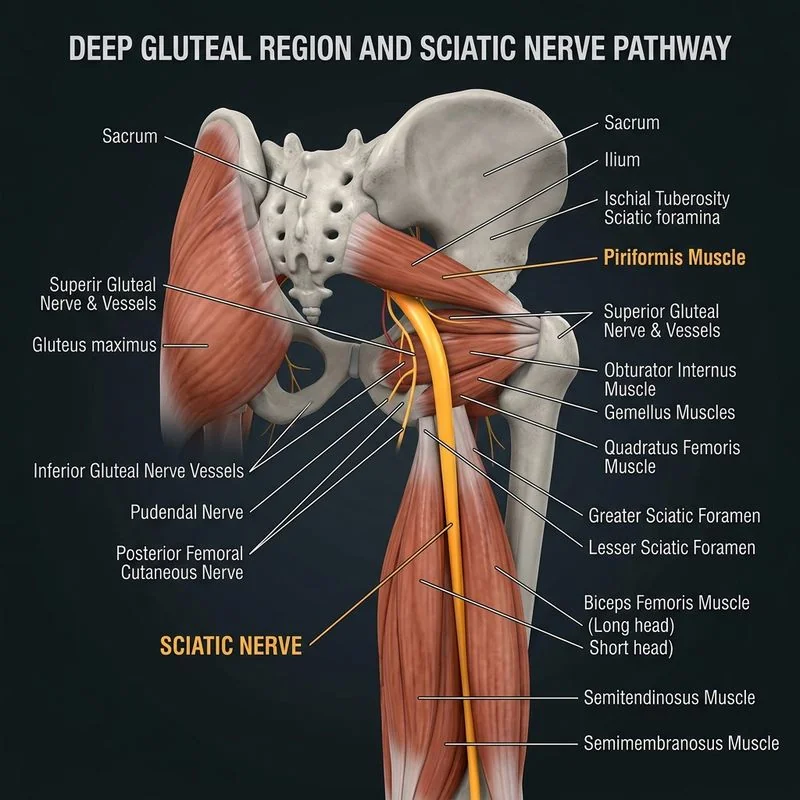
Biomechanical Anatomy & Nerve Path
Understanding the underlying spinal segments, nerve pathways, and joint lines allows us to apply precise manual techniques to decompress impingements without invasive procedures.
Clinical Insight
Every treatment at Be Your Therapist is administered directly by Dr. Anshika Maheshwari (MPT - Ortho) with specialized osteopathic and manual precision.
Our 4-Phase Non-Surgical Treatment Protocol
Phase 1: Deep Piriformis & Myofascial Release
Dry needling and manual trigger point deactivation directly into the piriformis, obturator internus, and gluteus medius to immediately unclamp the sciatic nerve.
Phase 2: Pelvic De-rotation & Joint Mobilisation
Osteopathic correction of pelvic torsions and SI joint alignments to widen the sciatic notch pathway.
Phase 3: Progressive Neural Gliding (Nerve Flossing)
Gentle neural mobilization to free nerve root adhesions from surrounding fascial sheaths without triggering inflammatory flares.
Phase 4: Lumbo-Pelvic Stability & Prevention
Conditioning the posterior chain and core stabilizers to protect the sciatic nerve during daily locomotion and sitting.
Expected Recovery Timeline
Days 1–5: Dramatic reduction in burning nerve pain and radiating leg pins-and-needles
Days 7–14: Restoration of comfortable walking, driving, and sitting tolerances
Days 21–28: Full neural mobility and zero residual tingling in toes
Clinical Home Exercise Prescriptions
Reinforce joint alignment between clinical sessions with these prescribed home drills.
Seated Sciatic Neural Floss
Focus: Nerve mobility
Figure-4 Piriformis Stretch
Focus: Deep gluteal decompression
Hamstring Active Mobility Release
Focus: Posterior nerve pathway relief
Integrated Therapies Used for this Condition
Frequently Asked Questions
What is the difference between Sciatica and simple lower back pain?
Back pain stays localized to the lumbar region, while sciatica specifically involves nerve compression causing radiating pain, burning, or numbness down the buttock, thigh, calf, and foot.
How does Dry Needling help Sciatica pain?
Dry needling releases deep trigger points in the piriformis muscle that cannot be reached by superficial massage, causing an instant relaxation of muscle tension around the sciatic nerve.
Can I exercise while having active sciatica pain?
High-impact exercise should be avoided, but specific gentle nerve flossing and McKenzie directional exercises are essential to speed up nerve decompression.
Ready to begin your recovery?
Book a 1-on-1 diagnostic consultation with Dr. Anshika Maheshwari at Be Your Therapist in Sector 78 Noida.