
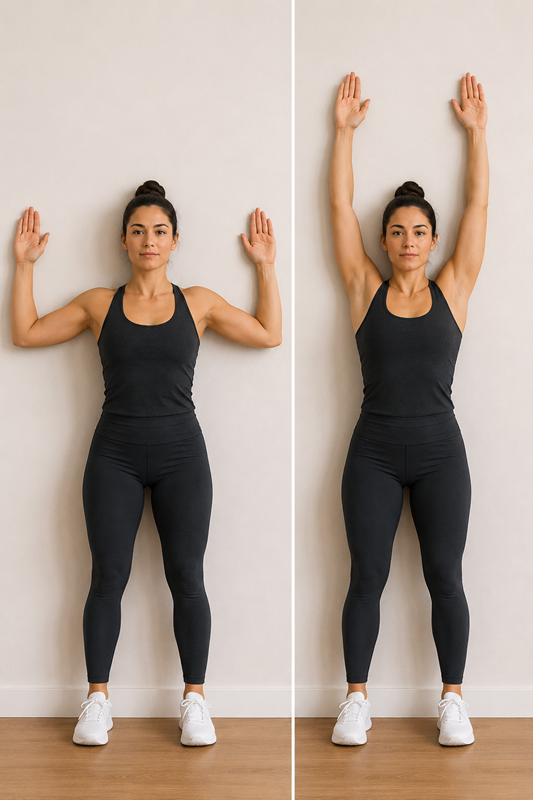
Wall Angels
"Active postural correction and scapular stabilizer activation"
Wall Angels are an active rehabilitation exercise designed to target the mid and lower trapezius, rhomboids, and shoulder stabilizers. By pressing your back, arms, and wrists against a wall and moving them dynamically, you activate key postural muscles and stretch tight pectorals. This is an essential clinical exercise for reversing slouched shoulders.
Target Reps
10-12 repsSets
3 setsHold Time
1 second squeeze at the bottomStep-by-Step Instructions
Stand with your back flat against a wall, with your heels about 6 inches away from the wall.
Ensure your lower back, upper back, and head are in constant contact with the wall.
Raise your arms to a 'W' position, with your shoulders, elbows, and back of your hands touching the wall.
Slowly slide your hands upward along the wall to form a 'Y' shape. Only slide as high as you can keep contact.
Slowly pull your elbows back down to the 'W' starting position, squeezing your shoulder blades together.
Biomechanical Form & Execution Analysis
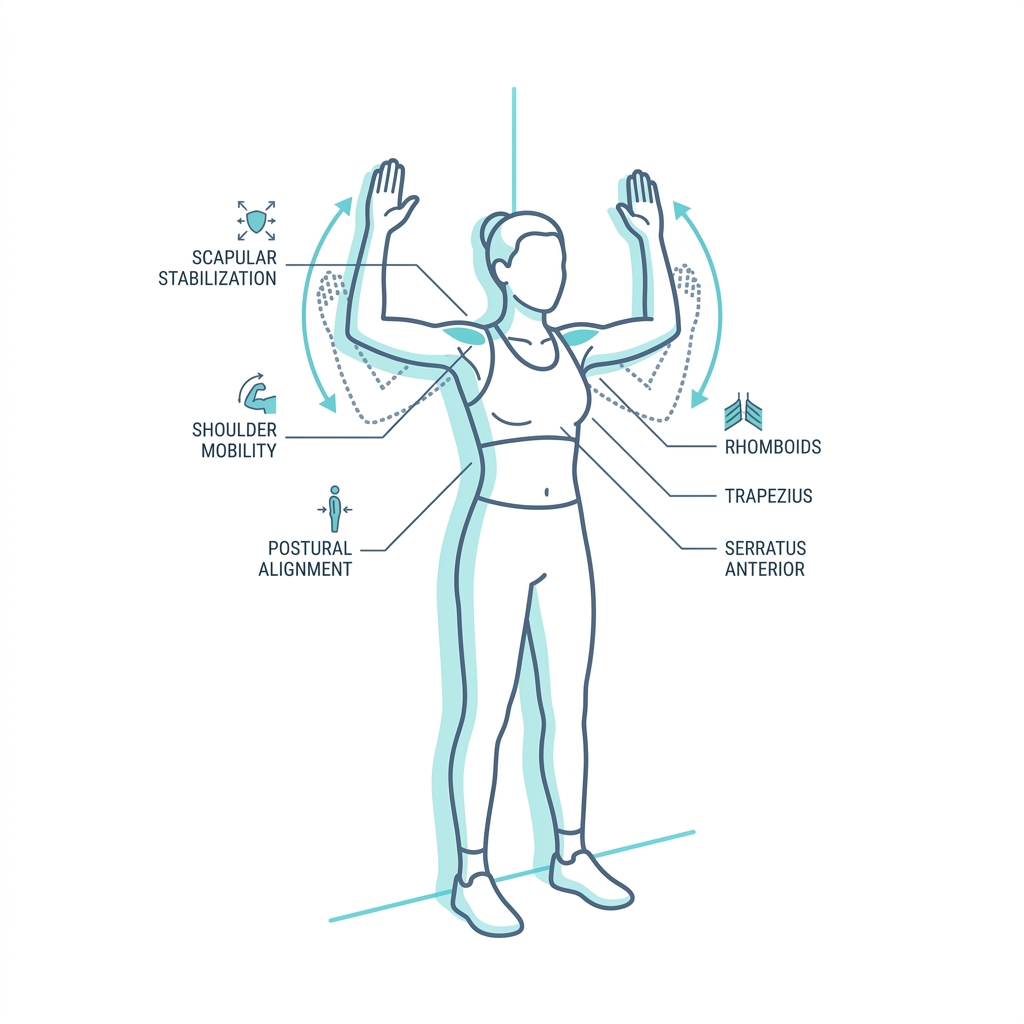
Key Alignment Focus Points
- Keep lower back flat against wall
- Keep elbows, wrists, and fingers touching wall throughout
- Slide arms upward while maintaining wall contact
Common Form Mistakes to Avoid
- Arching lower back off wall to achieve higher range
- Letting hands/wrists drift forward
- Shrugging shoulders up during slide
Biomechanical Benefits
- Strengthens the middle and lower trapezius and deep neck stabilizing muscles
- Stretches the pectorals and anterior shoulders to reverse rounded chest posture
- Improves scapular upward/downward rotation and shoulder blade tracking
- Combats 'text neck' and reduces strain at the base of the skull
Precautions & Safety
- Keep your lower back flat against the wall; do not let it arch as your arms slide up.
- Ensure your wrists and elbows stay in contact with the wall throughout the entire movement range.
- Reduce range of motion if you feel sharp pain in the front of your shoulder joints.
Experiencing severe or worsening pain?
Do not force through acute pain. Schedule a complete diagnostic physical assessment with Dr. Anshika Maheshwari to build a clinical treatment path tailored to your skeletal structure.